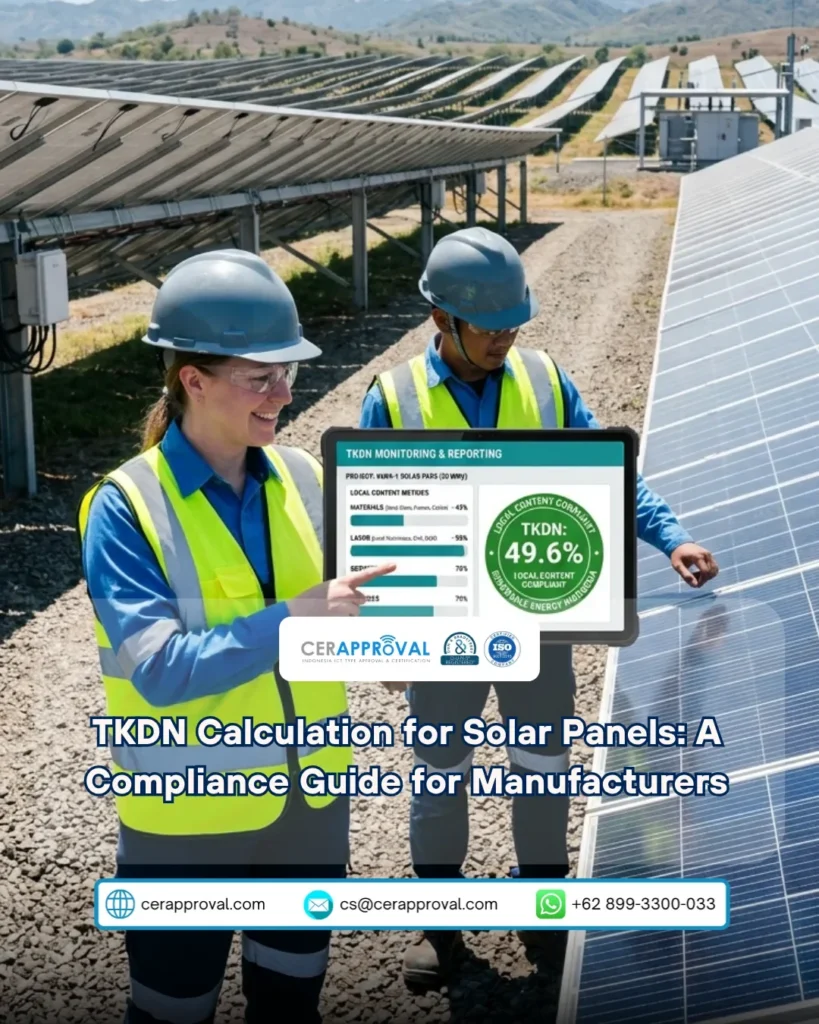
TKDN Calculation for Solar Panels: A Compliance Guide for Manufacturers
TKDN Calculation for Solar Panels helps manufacturers understand how Indonesia assesses domestic content in solar modules. For manufacturers, assemblers, and equipment suppliers, this knowledge helps them prepare for TKDN verification. Indonesia has introduced specific rules for measuring domestic content in industrial products. However, not every product follows the same calculation method. Solar modules have their own calculation framework, while the certification process follows the applicable general regulations. This guide explains the main calculation factors, their official weights, and the documents manufacturers should prepare. It also covers the steps involved in preparing for verification. Understanding TKDN Requirements for Solar Panels TKDN stands for Tingkat Komponen Dalam Negeri, or Domestic Component Level. It measures domestic content under Indonesia’s applicable regulations. The legal framework includes Law No. 3 of 2014 on Industry and Government Regulation No. 29 of 2018 on Industrial Empowerment. In addition, the Ministry of Industry (Kemenperin) issued Regulation No. 34 of 2024 to govern TKDN calculations for solar modules. Meanwhile, Regulation No. 35 of 2025 establishes a broader framework for TKDN and Company Benefit Weight (BMP) certification. Therefore, manufacturers should understand how the product calculation rules relate to the certification requirements. These two aspects serve different purposes. The first determines how manufacturers assess domestic content. The second governs the applicable certification process. Manufacturers should check both regulations before preparing an application. They should also review any relevant transitional provisions and current administrative requirements. Official references: Minister of Industry Regulation No. 34 of 2024 Minister of Industry Regulation No. 35 of 2025 Law No. 3 of 2014 on Industry TKDN Calculation for Solar Panels: Official Weighting Under Regulation No. 34 of 2024, solar module calculations cover three main production factors. Each factor has a specific weight in the overall assessment. Production factor Weight Direct materials 91% Direct labor 5% Factory overhead 4% Total 100% These weights apply to the solar module calculation framework. However, they do not represent the automatic TKDN value of a finished product. Instead, manufacturers must assess the relevant domestic content and apply the prescribed calculation method. The regulation also assigns specific weights to individual material components. Consequently, manufacturers should not calculate the final value by simply dividing local spending by total production costs. That approach does not capture all the requirements of the specific solar module methodology. 1. Direct Materials Direct materials account for 91% of the overall weighting. This category covers the materials and components identified in the applicable regulation. Examples include: Solar cells and their upstream production stages. Tempered glass. Photovoltaic junction boxes. Backsheets or bifacial materials. Frames. EVA film. Photovoltaic ribbon. Solar silicon. The regulation also distinguishes between stages in solar cell production. These stages include silica procurement, silicon production, ingot manufacturing, brick manufacturing, wafer production, blue cell production, and cell printing. Each relevant component has its own prescribed weight. For example, tempered glass has a weight of 12%, while frames have a weight of 9%. Photovoltaic junction boxes carry a weight of 8%. However, these figures do not automatically become the product’s TKDN percentage. Manufacturers must assess the domestic content of each relevant component according to the applicable criteria. For this reason, companies should keep clear records of component origins and manufacturing activities. These records help support the calculation during verification. 2. Direct Labor Direct labor accounts for 5% of the overall weighting. It relates to labor involved in the relevant manufacturing activities. Manufacturers should maintain employment and production records to support their assessment. For example, they can organize payroll records, employee assignments, and production reports. These documents help connect labor costs to the manufacturing process. However, companies must still follow the applicable rules when assessing domestic content. A consistent recordkeeping process also helps manufacturers identify missing information before submitting an application. 3. Factory Overhead Factory overhead accounts for 4% of the overall weighting. This category covers the relevant indirect factory costs considered under the regulation. Manufacturers should organize supporting accounting and production records. Depending on the applicable requirements, these records may cover utilities, maintenance, equipment, and other relevant factory expenses. However, companies should not automatically classify every expense incurred in Indonesia as domestic content. The prescribed calculation method determines how the relevant costs contribute to the assessment. How to Calculate TKDN Value for Solar Modules Manufacturers must apply the weighted calculation method established by the applicable regulation. In practice, they need to assess the relevant production factors and material components before applying their prescribed weights. The general concept can be expressed as follows: TKDN = Sum of the weighted domestic-content contributions under the applicable calculation method. This expression explains the principle behind the assessment. It does not replace the detailed formula and criteria in Regulation No. 34 of 2024 and its appendix. First, manufacturers identify the relevant production factors and components. Next, they assess domestic content according to the prescribed criteria. Finally, they apply the relevant weights to determine the calculated contribution. The direct materials category carries 91% of the overall weighting. Direct labor carries 5%, while factory overhead carries 4%. However, the weight of a component is not the same as its actual domestic-content contribution. The final result depends on the applicable assessment and supporting evidence. Why a Simple Cost Formula Is Not Enough A simple ratio of local expenditure to total production expenditure can help with internal financial analysis. Nevertheless, manufacturers should not present that ratio as the official solar module TKDN formula. The specific framework uses prescribed weights for production factors and material components. Therefore, a calculation based only on local purchasing costs may produce a different result from the official assessment. Manufacturers should use the official calculation format when preparing their documentation. They should also distinguish preliminary estimates from values established through the applicable verification process. Documents to Prepare for TKDN Verification Good documentation helps manufacturers support their calculations. Before applying, companies should organize records that match their product and the applicable certification requirements. Bill of Materials and Component Records Start with a Bill of Materials (BOM). This document should identify the relevant components, quantities, suppliers, and