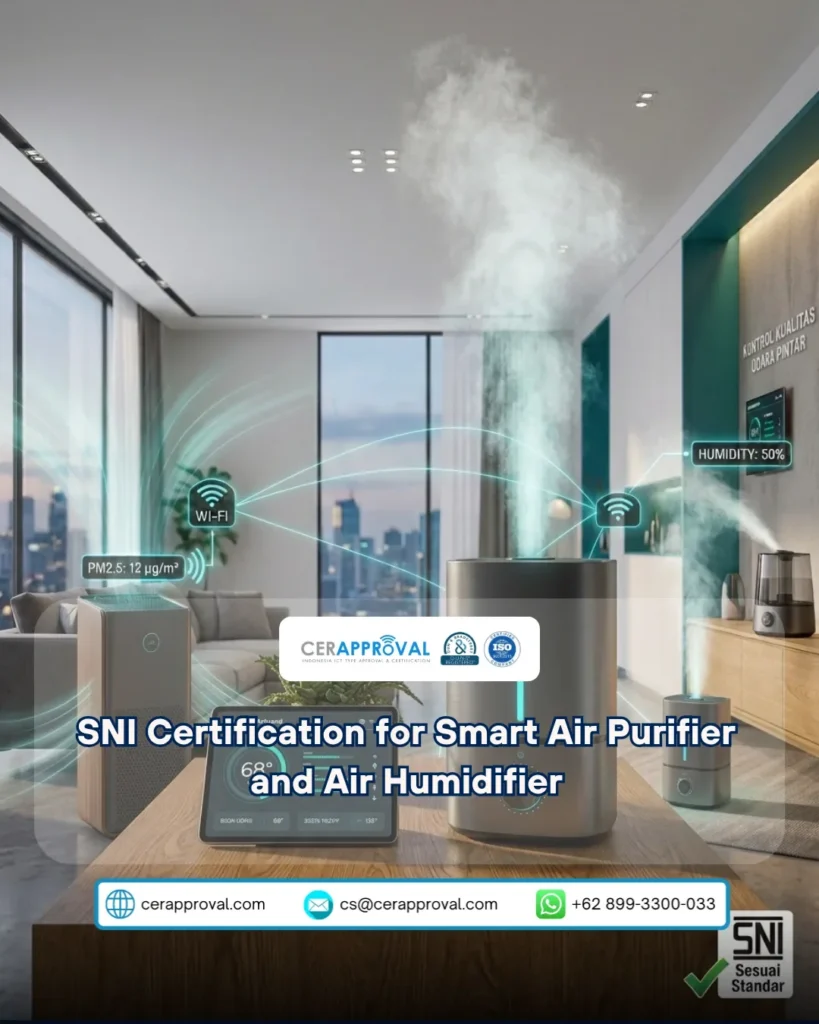
SNI Certification for Smart Air Purifier and Air Humidifier
Indoor air quality has become an important concern for households and businesses. As a result, smart air purifiers and air humidifiers are gaining attention in Indonesia. These devices use sensors, automated settings, and mobile applications to help users manage indoor air conditions. However, manufacturers and importers must consider Indonesian product compliance before entering the market. SNI certification for smart air purifier and air humidifier products is an important regulatory topic to review before distribution. The applicable requirements depend on the product type, technical specifications, and current regulations. This guide explains the certification process, the documents businesses may need, the role of product testing, and the additional requirements for wireless features. Why Is SNI Certification for Smart Air Purifier and Air Humidifier? SNI stands for Standar Nasional Indonesia, or Indonesian National Standard. These standards establish technical requirements for products and other regulated activities. For electrical appliances, product safety deserves particular attention. Air purifiers and humidifiers may operate for several hours each day. Therefore, manufacturers should assess electrical hazards, operating temperatures, insulation, and mechanical safety. SNI certification can also help businesses demonstrate product conformity when the relevant product category falls under a mandatory certification requirement. However, not every appliance automatically follows the same certification route. Before importing or selling a product, businesses should confirm whether a mandatory SNI regulation covers the specific model. Key Product Safety Considerations First, electrical safety testing may assess protection against electric shock, insulation performance, and abnormal operating conditions. These checks help identify potential hazards during normal use and foreseeable misuse. Second, thermal safety deserves attention. Motors, heating elements, power supplies, and other components may generate heat. Consequently, testing may examine temperature limits and the risk of overheating. Third, manufacturers should evaluate mechanical construction and material durability. For example, a humidifier must manage water near electrical components. An air purifier must also maintain safe airflow and reliable operation. Finally, businesses should check whether additional requirements apply to electromagnetic compatibility, labeling, or other product characteristics. The exact test scope depends on the applicable standard and regulatory framework. Which SNI Standards Apply to Smart Air Purifiers and Humidifiers? Selecting the correct standard is an essential early step. Household appliances may fall under relevant standards in the SNI IEC 60335 series, depending on their design and intended function. However, businesses should not assume that one standard automatically covers every air purifier and humidifier. An appliance with heating functions, an ultrasonic atomizer, or a different operating mechanism may require a different assessment. Therefore, the applicant should provide the product’s technical specifications to a qualified certification body, or LSPro. The certification body can help identify the applicable standard and assessment route. The review should consider the following information: Product type, model number, and intended use. Rated voltage, frequency, and power consumption. Electrical diagrams and component specifications. Heating, filtration, humidification, and control functions. Wireless connectivity and associated radio modules. Product labels, packaging, and user instructions. By identifying the correct requirements early, businesses can reduce unnecessary testing and avoid preparing an incomplete application. How to Process SNI Certification for Smart Air Purifiers and Humidifiers The certification process generally involves regulatory assessment, document preparation, product evaluation, and a certification decision. The precise sequence may vary according to the applicable regulation and certification scheme. Step 1: Identify the Applicable Requirements First, determine the product category and confirm whether SNI certification is mandatory. Review the current regulations and identify the relevant standard for each product model. At this stage, businesses should also establish whether the product requires additional approvals. For example, a model with Wi-Fi or Bluetooth may need separate telecommunications compliance. Step 2: Prepare the Technical Documents Next, prepare the documentation required by the selected certification body. Typical documents may include company registration records, product specifications, electrical schematics, component lists, and product photographs. Manufacturers should also prepare user manuals and labels in Bahasa Indonesia when the applicable rules require them. In addition, provide clear model identification and information about any differences between product variants. These details help the certification body determine whether the proposed product family can follow the same assessment route. Step 3: Arrange the Factory Assessment Depending on the certification scheme, the process may require an assessment of the manufacturing facility and its quality controls. During this assessment, the relevant parties may review production procedures, incoming material checks, testing equipment, and procedures for maintaining consistent product quality. An ISO 9001 certificate may support the quality management review, but it does not automatically replace a factory assessment when the applicable scheme requires one. Therefore, applicants should confirm the audit criteria, location requirements, and available assessment arrangements before scheduling the visit. Step 4: Complete Product Sampling and Testing After the initial review, the certification process may require product sampling and laboratory testing. The sampling procedure and eligible laboratory depend on the applicable certification scheme. Testing may evaluate electrical safety, temperature rise, insulation, mechanical strength, and resistance to relevant environmental conditions. Additional tests may apply to specific product designs. Moreover, electromagnetic compatibility testing may be necessary under applicable requirements. However, EMC testing and SNI certification are distinct assessments, even when both apply to the same product. If a sample fails, the manufacturer may need to investigate the cause, correct the design or manufacturing issue, and arrange further testing as required. Step 5: Complete Evaluation and Certification Once testing and any required factory assessments are complete, the certification body reviews the results and supporting documents. The LSPro then determines whether the application satisfies the relevant certification scheme. If the applicant meets all applicable requirements, the body can issue the relevant product certification documents. The term SPPT-SNI is commonly associated with certification for the use of the SNI mark. Applicants should confirm the applicable certificate terminology and current administrative procedure with the responsible certification body. Step 6: Apply Product Marking and Maintain Compliance After receiving the required approval, the business must follow the applicable rules for using the SNI mark. These rules may specify its placement, presentation, and supporting product information. Before releasing the product, check that the approved